
Divorce in England now works on a no-fault basis: you no longer have to blame your spouse or prove wrongdoing to end a marriage. Since April 2022, under the Divorce, Dissolution and Separation Act 2020, one or both spouses simply state that the marriage has broken down irretrievably, and the court process runs through two set waiting periods before the marriage legally ends (Get a divorce, GOV.UK). In practice that means even the smoothest divorce takes a minimum of around six months from application to final order. This guide explains each step, what happens about money and children, and where a solicitor genuinely earns their keep.
This article is general information, not legal advice. Every situation is different, so please speak to a solicitor about your own circumstances.
What no-fault divorce changed
Before April 2022, most divorcing couples had to cite a reason such as unreasonable behaviour or adultery, or wait years of separation. The no-fault system removed all of that. There is now a single ground: the irretrievable breakdown of the marriage, confirmed by a statement that the court must accept. A spouse can no longer contest the divorce itself in almost all cases [VERIFY — REGULATED: confirm wording on the very limited remaining grounds to dispute]. Couples can also apply jointly for the first time, which many find sets a more constructive tone for everything that follows.
To apply, you normally need to have been married for at least a year; the full eligibility rules are on GOV.UK [VERIFY — REGULATED: confirm the one-year rule wording and any exceptions].
The divorce process, step by step
1. The application. You apply online or by post, alone or jointly with your spouse, including your marriage certificate and paying the court fee (the current fee is listed on GOV.UK; help with fees is available for those on low incomes or certain benefits).
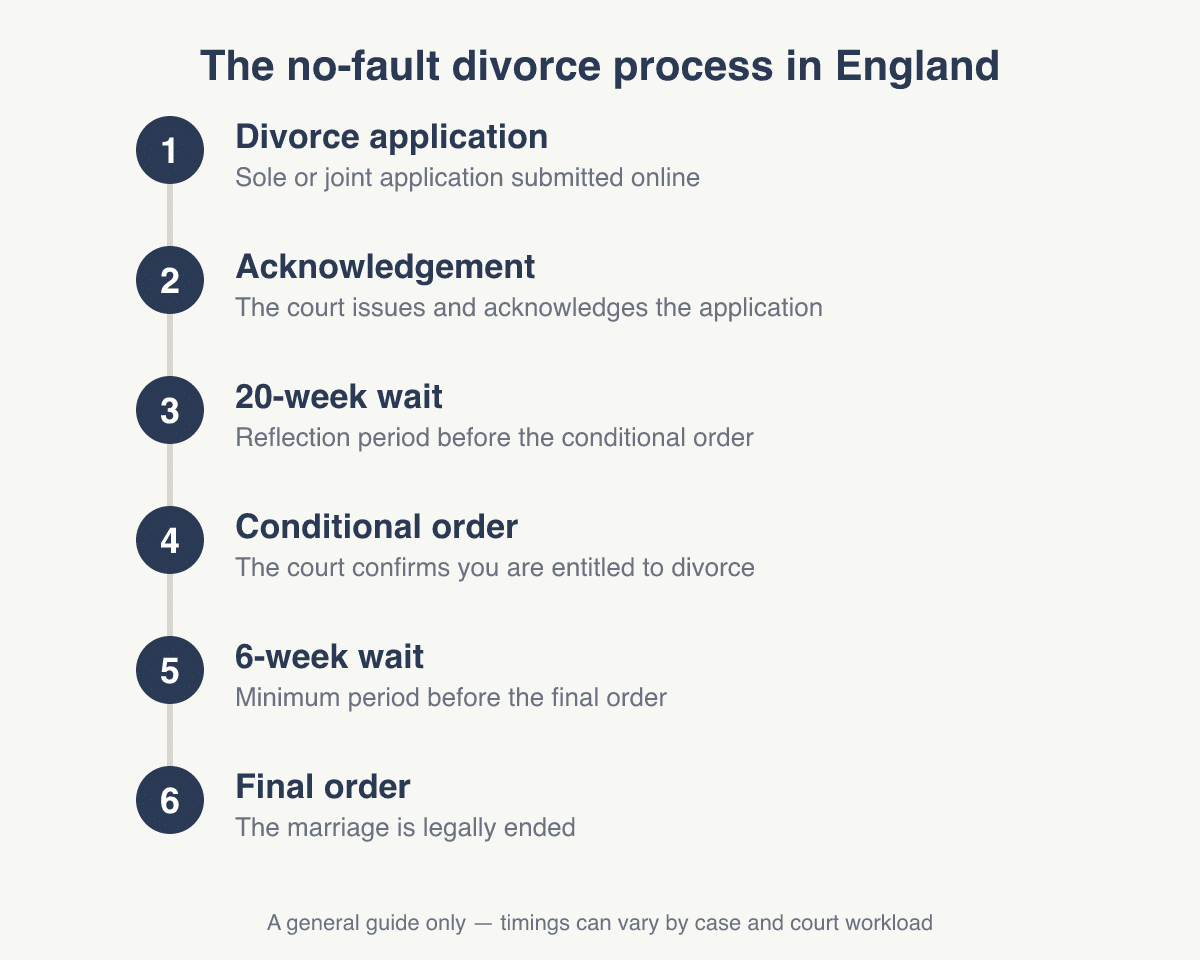
2. Acknowledgement. In a sole application, the court sends the application to your spouse, who must acknowledge it. In a joint application this stage falls away, which is one reason joint applications often run more smoothly.
3. The 20-week waiting period. You cannot apply for the next stage until at least 20 weeks after the application was issued (GOV.UK). This is built into the law as a reflection period, and in practice it is when most couples work through the practical side: finances, housing and arrangements for children.
4. The conditional order. After the 20 weeks you can apply for a conditional order, the court’s confirmation that you are entitled to divorce. It does not end the marriage by itself.
5. The final order. You must wait at least six weeks and one day after the conditional order before applying for the final order (GOV.UK). The final order is what legally ends the marriage.
Add the stages together and the legal minimum is a little over six months. Real timescales are often longer, usually because financial matters are being negotiated alongside.
Money and children are dealt with separately
A point that catches many people out: the divorce itself only ends the marriage. It does not automatically sort out money, property, pensions or arrangements for children. Financial claims between ex-spouses generally remain open until they are dealt with by a court order, which is why solicitors usually recommend resolving finances before applying for the final order [VERIFY — REGULATED: confirm framing on financial claims remaining open and timing advice re the final order].
We have covered both areas in more detail elsewhere on this site: see our guides to [financial settlements after separation → /financial-settlements-after-separation-uk/] and [child custody agreements in England → /how-child-custody-agreements-work-england/].
Do you need a solicitor for a no-fault divorce?
The application itself is designed to be straightforward, and some couples complete it without help. Where a solicitor matters is everything around it: negotiating and drafting a financial settlement that the court will approve, protecting pension rights, handling a former partner who will not engage, and making sure children’s arrangements are workable and properly recorded. A short conversation early on often prevents expensive problems later. Our [family law team → /family/] advises clients across Accrington, Blackburn, Burnley and the wider Lancashire area on divorce, finances and children, and will tell you plainly whether you need ongoing help or just a steer.
Frequently Asked Questions
How long does a no-fault divorce take in England?
The legal minimum is a little over six months: at least 20 weeks from application to conditional order, then at least six weeks and one day before the final order. Most divorces take longer, mainly because finances are settled alongside.
Can my spouse refuse the divorce?
Under the no-fault system a spouse can no longer contest the divorce simply because they disagree with it. Disputes now centre on finances and children rather than the divorce itself.
Should we apply jointly or alone?
A joint application suits couples who both accept the marriage is over and want to keep things cooperative. A sole application is available where one spouse will not engage. A solicitor can advise which fits your situation.
Does the final order settle our finances?
No. Financial matters are dealt with separately, and it is usually sensible to resolve them before the final order. Speak to a solicitor before applying for the final order if finances are not yet agreed.
Do we have to go to court in person?
Most no-fault divorces are dealt with online without anyone attending a hearing. Court hearings usually only arise where finances or children’s arrangements are disputed.
Talk to divorce solicitors in Accrington
Ending a marriage is hard enough without navigating the process alone. Abbey Court Solicitors supports clients through every stage of divorce, from the first application through to financial settlements and arrangements for children, with clear advice and no jargon. If you are considering divorce or have already started, contact our [family solicitors → /family/] for a confidential conversation about your options.
—
Reviewer notes
- Word count: approx. 1,020 (body, excluding front matter and notes).
- Sitemap check: live News page fetched 3 Aug 2026; no existing divorce-process post. Related but distinct live posts: “Why Hire Family Law Solicitors Near You for Divorce & Child Matters?” (hiring-focused, 2025), “Financial Settlements After Separation” and “Navigating Child Custody Agreements in England” (both linked from this draft). No duplication. Internal link targets verified live: /family/, /financial-settlements-after-separation-uk/, /how-child-custody-agreements-work-england/.
- Verification approach: regulated (legal) content at safe altitude. The 20-week and six-weeks-and-one-day periods and the April 2022 no-fault commencement are confirmed GOV.UK basics, cited inline (GOV.UK “Get a divorce”; confirmed via GOV.UK/HMCTS guidance pages 3 Aug 2026), so they carry no flag per the verification policy. The court fee is deliberately not quoted (signposted to GOV.UK instead). No outcome promises, no costs figures, no timescale promises.
- [VERIFY] flags (all REGULATED, for fee-earner sign-off):
- [VERIFY — REGULATED] Wording on the very limited remaining grounds to dispute a divorce.
- [VERIFY — REGULATED] The one-year marriage rule wording and any exceptions.
- [VERIFY — REGULATED] Framing that financial claims remain open until dealt with by court order, and the advice to resolve finances before the final order.